Love this? Save it for later!
Share the inspiration with your friends
The office potluck for Day of the Dead was in two days and I’d completely forgotten. Everyone else would be bringing elaborate altars of food—their grandmother’s mole, hand-rolled tamales, sugar skulls that took hours to decorate. I had a half-empty bag of flour, some butter that was about to expire, and a vague memory of a bread my neighbor’s abuela used to make when I was a kid. Pan de muerto. The bread of the dead. And I had never, not once, made it myself.
Honestly, I almost called in sick. But then I remembered that soft, orange-scented loaf she’d pull out of the oven every November 1st. The way the whole hallway would smell like warm butter and anise and something that felt like home. I figured, what’s the worst that could happen? I’d end up with a sad, dense brick and bring store-bought cookies as backup. So I grabbed that bag of flour and started mixing, half-convinced I was about to embarrass myself in front of the whole office.
Let me tell you, the panic was real. I was kneading dough at 11 pm on a Tuesday, flour on my jeans, muttering to myself about why I didn’t just buy something. But when that bread came out of the oven—golden, pillowy, smelling like a warm hug—I actually laughed out loud. It worked. It actually worked. I brought it to work the next day, still a little warm, and set it next to the elaborate spreads. And you know what happened? People kept coming back to my sad little loaf. They asked for the recipe. Someone said it reminded them of their own grandmother’s kitchen. Maybe you’ve been there—that moment when the simplest thing you made turns out to be the one everyone remembers.
That’s the thing about this cozy pan de muerto. It doesn’t need fancy ingredients or hours of your time. It just needs a little patience and the willingness to get your hands messy. And honestly, that’s what makes it so special. It’s not about perfection—it’s about the memories you’re making while you bake it. So whether you’re celebrating Day of the Dead or just want a beautiful, comforting bread to share, this is the recipe that stuck with me. And I think it’ll stick with you too.
Why You’ll Love This Recipe
I’ve tested this pan de muerto recipe more times than I care to admit. The first few attempts were… let’s just say, edible but not shareable. But after tweaking the hydration, playing with the proofing times, and getting the orange blossom water ratio just right, I landed on a version that’s genuinely foolproof. Here’s why I think you’ll love it as much as I do:
- Quick & Easy: This comes together in about 3 hours from start to finish—most of that is hands-off rising time. Perfect for a cozy afternoon bake or a last-minute Day of the Dead celebration.
- Simple Ingredients: No fancy bakery trips needed. Flour, butter, eggs, sugar, and a few pantry staples are all it takes. You probably have most of it already.
- Perfect for Day of the Dead: This is the traditional bread for altars and celebrations, but it’s also wonderful for any fall gathering. It’s a conversation starter and a comfort food all in one.
- Crowd-Pleaser: I’ve brought this to potlucks, family dinners, and even a book club. It always gets devoured. Kids love the soft texture, and adults appreciate the subtle floral notes.
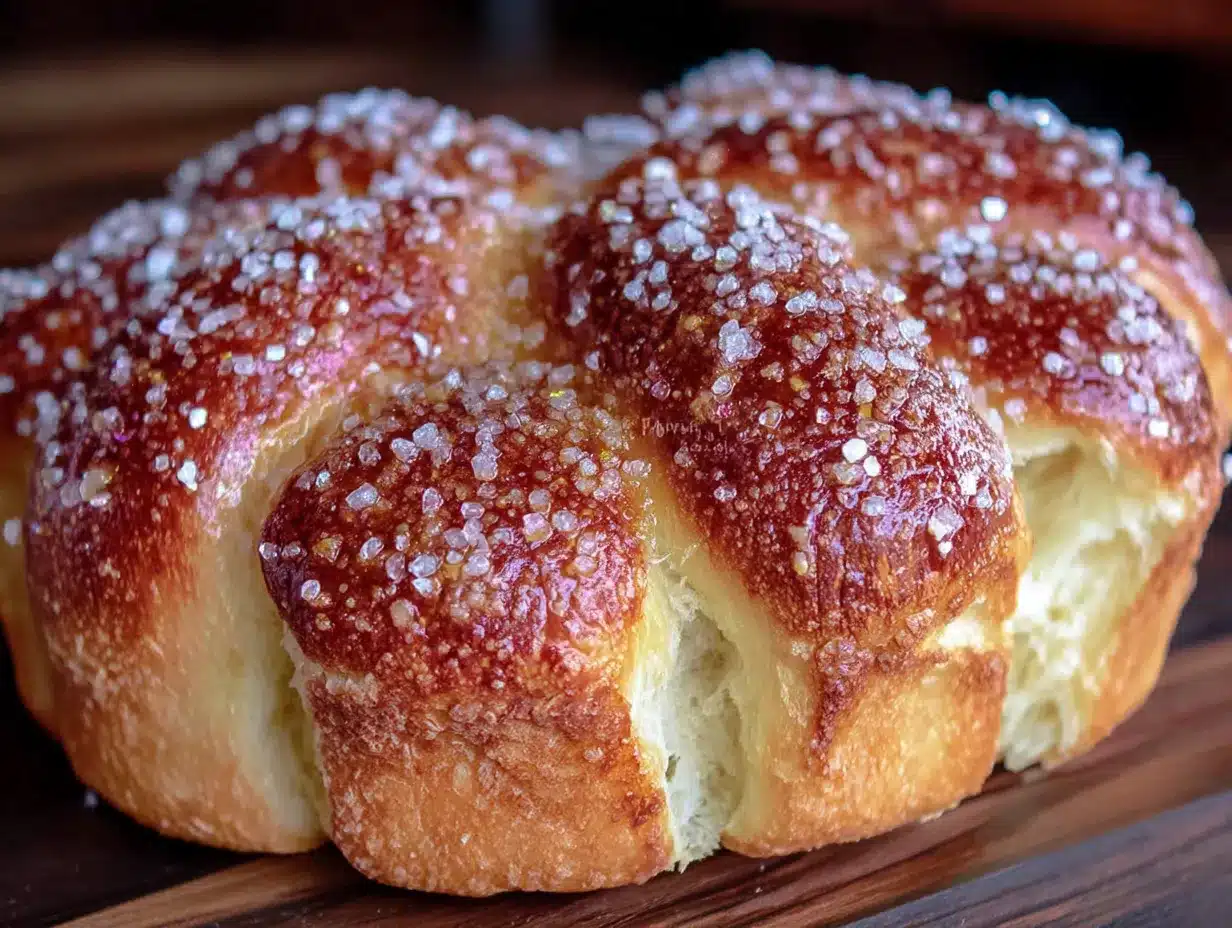
- Unbelievably Delicious: The texture is light and fluffy, with a hint of orange and a delicate sweetness. The butter glaze on top gives it that perfect golden crust. It’s next-level comfort bread.
What makes this version different from the rest? It’s the technique of using a tangzhong starter—a simple flour-and-water paste that keeps the bread incredibly soft for days. I learned this from a Japanese baking book and adapted it for this traditional Mexican bread. The result is a pan de muerto that stays fresh longer and has that melt-in-your-mouth texture we all crave. It’s not just another recipe—it’s my best version, tested and approved by everyone who’s tried it.
This bread isn’t just good—it’s the kind that makes you close your eyes after the first bite. It’s comfort food reimagined for a special occasion, but simple enough for any day you want to feel connected to tradition.
What Ingredients You Will Need
This recipe uses simple, wholesome ingredients to deliver that signature soft, slightly sweet bread with a beautiful floral aroma. Most of these are pantry staples, which makes this an easy bread to whip up whenever the mood strikes. Here’s what you’ll need:
For the Tangzhong Starter
- 2 tablespoons bread flour (all-purpose works too, but bread flour gives a better structure)
- 1/4 cup water (60 ml)
- 1/4 cup whole milk (60 ml)
For the Dough
- 2 1/2 cups bread flour (315 grams, plus more for dusting—I prefer King Arthur for consistent results)
- 1/4 cup granulated sugar (50 grams)
- 1 packet active dry yeast (2 1/4 teaspoons, or 7 grams)
- 1/2 teaspoon salt
- 1 teaspoon anise seeds (optional but traditional—gives that subtle licorice note)
- 2 large eggs (room temperature, beaten)
- 1/4 cup unsalted butter (56 grams, softened—I use Kerrygold for the rich flavor)
- 1 tablespoon orange blossom water (find it in the international aisle or a Latin grocery store)
- 1 teaspoon orange zest (from about 1 orange—this is where the brightness comes from)
- 1/3 cup warm water (about 110°F, or 80 ml—warm to the touch but not hot)
For the Glaze & Decoration
- 2 tablespoons unsalted butter (melted)
- 2 tablespoons granulated sugar (for sprinkling)
- 1/4 cup all-purpose flour (for shaping the bone decorations)
- 1 egg yolk (for egg wash, mixed with 1 tablespoon water)
A few ingredient notes: The orange blossom water is the secret ingredient here. It adds a floral, almost honey-like aroma that makes this bread unmistakably pan de muerto. If you can’t find it, you can substitute with 1 teaspoon of orange extract mixed with 2 tablespoons of water—but honestly, the real stuff is worth tracking down. I found mine at a local Mexican market for under $5. For the anise seeds, they’re optional but traditional. If you’re not a fan of licorice, just leave them out. The bread will still be delicious.
For substitutions: You can use all-purpose flour instead of bread flour, but the texture will be slightly less chewy and soft. For a dairy-free version, substitute the butter with vegan butter and use oat milk in the tangzhong. If you’re gluten-sensitive, I haven’t tested this with gluten-free flour, but a 1:1 gluten-free baking blend might work—just expect a denser result.
One more tip: Make sure your eggs and butter are at room temperature. Cold ingredients will shock the yeast and make the dough harder to work with. I usually take them out of the fridge an hour before I start baking.
Equipment Needed
You don’t need a professional bakery setup for this one. Here’s what I use and what you can substitute if needed:
- Stand mixer with dough hook: This makes kneading a breeze, but you can absolutely knead by hand. It’ll take about 10-12 minutes of arm work, which is honestly kind of therapeutic.
- Large mixing bowl: Glass or stainless steel works best. I use a ceramic bowl because it holds warmth nicely for proofing.
- Baking sheet: A standard half-sheet pan lined with parchment paper. No need for anything fancy.
- Small saucepan: For making the tangzhong starter. Any small pot will do.
- Pastry brush: For the egg wash and butter glaze. A silicone one is easiest to clean.
- Kitchen scale: Not mandatory, but I highly recommend it for accuracy. Bread baking is more science than art, and grams are your friend.
- Plastic wrap or a clean kitchen towel: For covering the dough while it rises.
- Cooling rack: Helps the bread cool evenly so the bottom doesn’t get soggy.
If you don’t have a stand mixer, don’t worry. I made this bread by hand for years before I got my KitchenAid. The key is to knead until the dough is smooth and elastic—it should spring back when you poke it. And if you don’t have a pastry brush, you can use a paper towel to dab on the egg wash. It’s not pretty, but it works.
Preparation Method
- Make the tangzhong starter. In a small saucepan, whisk together the 2 tablespoons bread flour, 1/4 cup water, and 1/4 cup milk. Cook over medium heat, stirring constantly, until it thickens into a paste—about 2-3 minutes. It should look like thick pudding. Remove from heat and let it cool to room temperature. This step is what keeps your bread soft for days.
- Activate the yeast. In a small bowl, combine the 1/3 cup warm water, 1 tablespoon of the sugar, and the yeast. Stir gently and let it sit for 5-10 minutes until it’s foamy and smells like bread. If it doesn’t foam, your yeast might be dead—start over with fresh yeast. I learned this the hard way after a flat, sad loaf.
- Mix the dough. In the bowl of your stand mixer (or a large mixing bowl), combine the 2 1/2 cups bread flour, remaining sugar, salt, and anise seeds. Add the tangzhong starter, activated yeast mixture, beaten eggs, softened butter, orange blossom water, and orange zest. Mix on low speed with the dough hook until everything comes together—about 2 minutes. The dough will look shaggy and sticky. That’s normal.
- Knead the dough. Increase the speed to medium and knead for 8-10 minutes (12-15 minutes if kneading by hand). The dough should become smooth, elastic, and slightly tacky but not sticky. It should pass the windowpane test—stretch a small piece of dough; if it stretches thin enough to see light through without tearing, you’re done. If it tears, keep kneading for another 2 minutes and test again.
- First rise. Shape the dough into a ball and place it in a lightly greased bowl. Cover with plastic wrap or a damp kitchen towel. Let it rise in a warm, draft-free spot for 1-1.5 hours, or until it has doubled in size. I like to put it in my oven with the light on—it’s the perfect temperature. Pro tip: If your kitchen is cold, microwave a cup of water for 2 minutes, then put the bowl in the microwave with the hot water. The steam and warmth speed things up.
- Shape the dough. Punch down the dough to release the air. Turn it out onto a lightly floured surface. Cut off about 1/4 cup of the dough and set it aside for the decorations. Shape the remaining dough into a round loaf by tucking the edges under. Place it on your parchment-lined baking sheet. Now, take the reserved dough and divide it into 4 equal pieces. Roll each piece into a rope about 6 inches long. These will be your “bones.” Arrange them on top of the loaf in a crisscross pattern, pressing the ends gently into the sides of the loaf. Traditional pan de muerto has two bones crossing in the middle, but you can get creative—I’ve seen people make a simple cross or even a star shape.
- Second rise. Cover the shaped loaf loosely with plastic wrap and let it rise for another 45 minutes to 1 hour. It should look puffy and almost doubled again. Don’t skip this step—the second rise is what gives the bread its light, airy texture.
- Preheat and glaze. About 20 minutes before the second rise is done, preheat your oven to 350°F (175°C). In a small bowl, mix the egg yolk with 1 tablespoon of water. Gently brush the entire loaf with the egg wash—be careful not to deflate the dough. This gives it that beautiful golden-brown color.
- Bake. Place the baking sheet in the preheated oven and bake for 25-30 minutes, or until the top is deep golden brown and the loaf sounds hollow when tapped on the bottom. If it’s browning too quickly, tent it loosely with foil after 15 minutes. Every oven is different—mine runs hot, so I start checking at 22 minutes.
- Glaze and cool. As soon as the bread comes out of the oven, brush the top with the melted butter. Immediately sprinkle generously with granulated sugar. Let it cool on the baking sheet for 10 minutes, then transfer to a cooling rack. The sugar will stick to the butter and create that signature sweet, crunchy top. Resist the urge to slice into it while it’s hot—the texture sets as it cools. I know it’s hard, but trust me on this one.
Cooking Tips & Techniques
I’ve made this pan de muerto at least a dozen times, and I’ve made every mistake in the book. Here’s what I’ve learned so you don’t have to repeat my errors:
Don’t skip the tangzhong. I know it’s an extra step, but it’s the secret to bread that stays soft for 3-4 days. Without it, your pan de muerto will be dry by the next morning. I tried skipping it once because I was in a hurry, and the bread was sad and crumbly. Never again.
Temperature matters more than you think. Your water for the yeast should be warm, not hot—about 110°F. If it’s too hot, it’ll kill the yeast. Too cold, and the yeast won’t activate. I use a kitchen thermometer, but if you don’t have one, the water should feel like a warm bath on your wrist. Also, make sure your eggs and butter are at room temperature. Cold ingredients can shock the dough and slow down the rise.
Knead until it passes the windowpane test. This is the biggest difference between good bread and great bread. Under-kneaded dough won’t have enough gluten structure, and your bread will be dense. Over-kneaded dough will be tough. The windowpane test is your best friend—stretch a piece of dough until it’s thin enough to see light through. If it tears, keep kneading. If it stretches without tearing, you’re done.
Watch the proofing times. The first rise should double the dough, but don’t let it go too long. Over-proofed dough will collapse in the oven. I set a timer for 1 hour and check it. If it’s not doubled, I give it another 15 minutes. The second rise is shorter but just as important—don’t rush it.
Multitasking tip: While the dough is on its first rise, clean up your workspace and set out your ingredients for the glaze. When it’s on the second rise, preheat the oven and make your egg wash. This way, you’re not scrambling at the end. I learned this after burning my fingers trying to brush glaze on a hot loaf while the timer was beeping.
One more thing: If your bread is browning too quickly in the oven, tent it with foil. Don’t open the oven door too often—the temperature drops and your bread won’t rise as well. I check mine once at 15 minutes, then again at 25. That’s it.
Variations & Adaptations
One of the best things about pan de muerto is how adaptable it is. Here are a few variations I’ve tried and loved:
Chocolate Pan de Muerto: Reduce the flour by 1/4 cup and add 1/4 cup unsweetened cocoa powder. Increase the sugar by 2 tablespoons. The chocolate version is rich and decadent—perfect for chocolate lovers. I made this for a friend who doesn’t like anise, and she ate half the loaf in one sitting.
Vegan Version: Substitute the butter with vegan butter, use flax eggs (1 tablespoon ground flaxseed mixed with 3 tablespoons water per egg), and use oat milk in the tangzhong. The texture will be slightly denser, but it’s still delicious. I tested this for a vegan coworker, and she said it reminded her of her grandmother’s bread. That was the best compliment I’ve ever gotten.
Gluten-Free Adaptation: I’ve had mixed results with gluten-free flour blends, but a 1:1 baking blend with xanthan gum works best. The dough will be stickier and harder to shape, so wet your hands with water to handle it. The texture won’t be as airy, but the flavor is still there. I recommend Cup4Cup or Bob’s Red Mill 1:1 for best results.
Seasonal Twist: In the fall, add 1 teaspoon of pumpkin pie spice to the dough for a warming, autumnal flavor. In the spring, swap the orange blossom water for rose water and add dried rose petals to the glaze. I made the rose version for a spring brunch, and it was absolutely gorgeous.
Savory Version: Reduce the sugar to 1 tablespoon, omit the orange blossom water and anise seeds, and add 1 teaspoon of dried rosemary and 1/2 cup of shredded cheese (like manchego or queso fresco). Shape it into small rolls instead of a loaf. This is amazing with soup or as a side for a Day of the Dead dinner.
Serving & Storage Suggestions
Pan de muerto is best served at room temperature or slightly warm. I love it with a cup of Mexican hot chocolate or a strong coffee—the sweetness of the bread pairs perfectly with the bitterness of the coffee. For a traditional Day of the Dead altar, place the bread alongside marigolds, photos of loved ones, and a glass of water. It’s a beautiful way to honor the tradition.
If you’re serving it for breakfast (which I highly recommend), try it with a smear of butter and a drizzle of honey. Or, for a dessert, serve it with a scoop of vanilla ice cream and a sprinkle of cinnamon. The possibilities are endless.
Storage: Store the bread in an airtight container at room temperature for up to 4 days. Do not refrigerate—it will dry out the bread. If you need to keep it longer, wrap it tightly in plastic wrap and freeze for up to 3 months. To thaw, leave it at room temperature for a few hours, then warm it in a 300°F oven for 5-10 minutes. The tangzhong starter helps the bread stay soft even after freezing.
Reheating: The best way to reheat is in a 300°F oven for 5-7 minutes. This brings back the crust’s crispness without drying out the inside. If you’re in a hurry, microwave it for 10-15 seconds, but the texture won’t be as good. Honestly, I never have leftovers to reheat—this bread disappears fast.
Flavor development: The flavors actually improve after a day. The orange and anise notes mellow and blend together beautifully. So if you can wait, bake it a day ahead. The bread will be even better on Day of the Dead.
Nutritional Information & Benefits
This recipe makes one large loaf, which serves about 8-10 people. Per serving (based on 8 servings):
- Calories: 285
- Fat: 10g
- Carbohydrates: 42g
- Protein: 7g
- Fiber: 1g
- Sugar: 12g
While this is a treat bread, it does have some redeeming qualities. The eggs provide high-quality protein and essential vitamins like B12 and D. The butter adds vitamin A for healthy skin and eyes. And the orange zest gives you a small dose of vitamin C and antioxidants. The anise seeds, if you use them, have been traditionally used to aid digestion—perfect after a heavy Day of the Dead meal.
Dietary considerations: This recipe contains gluten, dairy, and eggs. For a dairy-free version, see the variations section. For a gluten-free version, use a 1:1 gluten-free baking blend. This bread is not low-carb or keto-friendly due to the flour and sugar content, but it’s a wonderful occasional indulgence that connects you to tradition and family.
Personally, I believe that food is about more than numbers. Yes, this bread has sugar and butter. But it also has love, tradition, and the memory of loved ones. That’s something no nutrition label can measure.
Conclusion
This cozy pan de muerto is more than just a recipe—it’s a way to connect with tradition, honor loved ones, and fill your kitchen with the most incredible aroma. It’s the bread that saved me from a potluck disaster, and it’s the bread that I now make every year for Day of the Dead. It’s simple enough for a beginner baker but special enough for a celebration.
I hope you give it a try, whether you’re celebrating Day of the Dead or just want a beautiful, comforting bread to share with people you love. Don’t be afraid to make it your own—add different flavors, shape it differently, or serve it with your favorite toppings. The best recipes are the ones that become part of your own story.
If you make this pan de muerto, I’d love to hear about it. Leave a comment below and let me know how it turned out—did you make any changes? What did you serve it with? And if you’re making it for Day of the Dead, tell me who you’re remembering. I think that’s the most beautiful part of this tradition—the way food brings us closer to the people we’ve loved and lost.
Happy baking, and hasta la próxima. Until next time.
Frequently Asked Questions
Can I make pan de muerto without a stand mixer?
Absolutely! I made this bread by hand for years before I got a stand mixer. Just knead the dough on a lightly floured surface for 10-12 minutes until it’s smooth and elastic. It’s a great arm workout, honestly.
Why didn’t my pan de muerto rise?
This usually happens for one of three reasons: your yeast was too old or dead, your water was too hot and killed the yeast, or your kitchen was too cold for proofing. Always check that your yeast is foamy before adding it to the flour, and proof in a warm spot like your oven with the light on.
Can I freeze pan de muerto?
Yes! Wrap the cooled loaf tightly in plastic wrap, then in foil, and freeze for up to 3 months. To serve, thaw at room temperature and warm in a 300°F oven for 5-10 minutes. The tangzhong starter helps it stay soft even after freezing.
What can I use instead of orange blossom water?
If you can’t find orange blossom water, you can substitute with 1 teaspoon of orange extract mixed with 2 tablespoons of water. Or simply use 1 tablespoon of fresh orange juice and an extra 1/2 teaspoon of orange zest. The flavor won’t be exactly the same, but it’ll still be delicious.
How do I shape the bone decorations on top?
After the first rise, cut off about 1/4 cup of dough and divide it into 4 equal pieces. Roll each piece into a rope about 6 inches long. Place two ropes on top of the loaf in a cross shape, then place the other two ropes on top in the opposite direction to create a crisscross pattern. Press the ends gently into the sides of the loaf so they stick during baking.
Pin This Recipe!
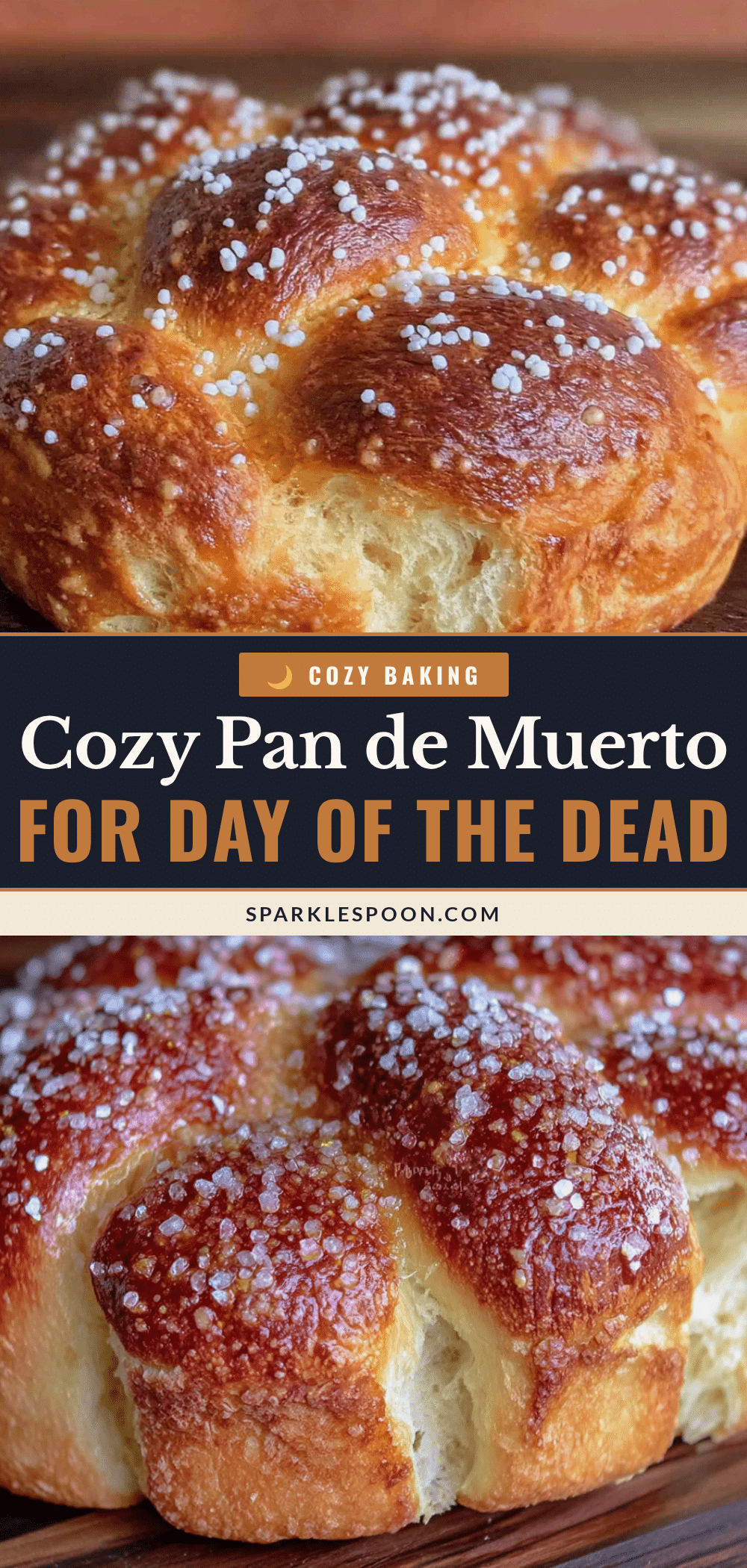
Cozy Pan de Muerto: Easy Day of the Dead Bread Recipe
This easy pan de muerto recipe delivers a soft, orange-scented bread that’s perfect for Day of the Dead celebrations or any fall gathering. With a tangzhong starter for extra softness and simple pantry ingredients, it’s a foolproof way to make this traditional Mexican bread at home.
- Prep Time: 20 minutes
- Cook Time: 30 minutes
- Total Time: 3 hours (includes rising time)
- Yield: 8-10 servings 1x
- Category: Bread
- Cuisine: Mexican
Ingredients
- 2 tablespoons bread flour (for tangzhong)
- 1/4 cup water (60 ml, for tangzhong)
- 1/4 cup whole milk (60 ml, for tangzhong)
- 2 1/2 cups bread flour (315 grams, plus more for dusting)
- 1/4 cup granulated sugar (50 grams)
- 1 packet active dry yeast (2 1/4 teaspoons, or 7 grams)
- 1/2 teaspoon salt
- 1 teaspoon anise seeds (optional)
- 2 large eggs (room temperature, beaten)
- 1/4 cup unsalted butter (56 grams, softened)
- 1 tablespoon orange blossom water
- 1 teaspoon orange zest (from about 1 orange)
- 1/3 cup warm water (about 110°F, or 80 ml)
- 2 tablespoons unsalted butter (melted, for glaze)
- 2 tablespoons granulated sugar (for sprinkling)
- 1/4 cup all-purpose flour (for shaping bone decorations)
- 1 egg yolk (for egg wash, mixed with 1 tablespoon water)
Instructions
- Make the tangzhong starter: In a small saucepan, whisk together 2 tablespoons bread flour, 1/4 cup water, and 1/4 cup milk. Cook over medium heat, stirring constantly, until it thickens into a paste (about 2-3 minutes). Remove from heat and let cool to room temperature.
- Activate the yeast: In a small bowl, combine 1/3 cup warm water, 1 tablespoon of the sugar, and the yeast. Stir gently and let sit for 5-10 minutes until foamy.
- Mix the dough: In the bowl of a stand mixer (or large mixing bowl), combine 2 1/2 cups bread flour, remaining sugar, salt, and anise seeds. Add the tangzhong starter, activated yeast mixture, beaten eggs, softened butter, orange blossom water, and orange zest. Mix on low speed until everything comes together (about 2 minutes).
- Knead the dough: Increase speed to medium and knead for 8-10 minutes (12-15 minutes by hand) until smooth, elastic, and slightly tacky. It should pass the windowpane test.
- First rise: Shape dough into a ball and place in a lightly greased bowl. Cover with plastic wrap or a damp towel. Let rise in a warm, draft-free spot for 1-1.5 hours until doubled in size.
- Shape the dough: Punch down the dough. Turn out onto a lightly floured surface. Cut off about 1/4 cup of dough and set aside. Shape remaining dough into a round loaf and place on a parchment-lined baking sheet. Divide reserved dough into 4 equal pieces, roll each into a 6-inch rope, and arrange in a crisscross pattern on top of the loaf, pressing ends gently into the sides.
- Second rise: Cover shaped loaf loosely with plastic wrap and let rise for 45 minutes to 1 hour until puffy and almost doubled.
- Preheat and glaze: About 20 minutes before second rise is done, preheat oven to 350°F (175°C). Mix egg yolk with 1 tablespoon water. Gently brush entire loaf with egg wash.
- Bake: Bake for 25-30 minutes until deep golden brown and loaf sounds hollow when tapped on the bottom. If browning too quickly, tent with foil after 15 minutes.
- Glaze and cool: As soon as bread comes out of the oven, brush top with melted butter and immediately sprinkle generously with granulated sugar. Let cool on baking sheet for 10 minutes, then transfer to a cooling rack.
Notes
The tangzhong starter is key for keeping the bread soft for days. Make sure eggs and butter are at room temperature. Orange blossom water is the secret ingredient; find it at Latin grocery stores or online. For substitutions: use all-purpose flour instead of bread flour (slightly less chewy), or for dairy-free use vegan butter and oat milk. The bread can be frozen for up to 3 months. Flavors improve after a day.
Nutrition
- Serving Size: 1 slice (based on 8
- Calories: 285
- Sugar: 12
- Sodium: 150
- Fat: 10
- Saturated Fat: 5
- Carbohydrates: 42
- Fiber: 1
- Protein: 7
Keywords: pan de muerto, Day of the Dead bread, Mexican sweet bread, orange bread, traditional bread, fall baking, holiday bread