Love this? Save it for later!
Share the inspiration with your friends
My neighbor, a quiet guy named Leo who keeps to himself, asked why I couldn’t just make the gravy the day before Thanksgiving. I started to explain why that wouldn’t work — something about the flavor needing to come together fresh, about the drippings being the whole point. Then I stopped. Honestly, I had no good reason. I was just repeating what I’d always been told. So I tried it his way. I roasted a few turkey parts earlier in the week, made the stock, and built the gravy from scratch a full twenty-four hours before the big meal. The result was so good, so deeply savory, that I felt a little embarrassed I hadn’t thought of it myself. The texture was perfect, the flavor had time to settle, and I wasn’t a frantic mess on Thursday morning. Maybe you’ve been there — sweating over a hot stove while guests are already pouring wine. This make-ahead gravy changed my Thanksgiving forever. I keep making it because it proves that the best traditions aren’t always the ones we inherit. Sometimes, they’re the ones we’re brave enough to question.
Why You’ll Love This Recipe
This isn’t just another gravy recipe. It’s a game-changer for holiday cooking. I’ve tested it through three Thanksgivings, two Christmas dinners, and one very tense Easter brunch. It works every single time.
- Stress-Free Holiday Prep: Make it up to three days ahead. Reheat gently while your turkey rests. No last-minute whisking panic.
- Simple Pantry Ingredients: You need turkey parts, butter, flour, and basic aromatics. Nothing fancy, nothing hard to find.
- Perfect for Large Gatherings: This recipe scales beautifully. Feed eight or eighteen with the same method.
- Crowd-Pleasing Flavor: Rich, savory, with that deep roasted taste everyone craves. Adults and kids both ask for seconds.
- Unbelievably Silky Texture: The secret is a slow simmer and a proper roux. No lumps, no greasy film, just pure smoothness.
What makes this different from other recipes is the make-ahead approach itself. Most gravies are rushed, thrown together with turkey drippings and a prayer. This one gets a full hour of simmering time, letting the flavors develop into something truly special. It’s the kind of gravy that makes you close your eyes after the first bite. Comfort food at its finest, with none of the holiday chaos attached.
What Ingredients You Will Need
This recipe uses simple, wholesome ingredients to deliver bold, savory flavor. Most are pantry staples you probably already have on hand.
- Turkey wings or legs (2-3 pounds) — These provide deep roasted flavor. I prefer turkey wings for their higher skin-to-meat ratio, which means more browning and richer stock.
- Unsalted butter (1/2 cup, 1 stick) — Controls the salt level in your roux. I use Kerrygold for its creaminess, but any good unsalted butter works.
- All-purpose flour (1/2 cup) — The foundation of your roux. Spoon and level it for accuracy. No scooping straight from the bag.
- Yellow onion (1 large, roughly chopped) — Adds sweetness and depth. Leave the skin on for richer color.
- Carrots (2 medium, roughly chopped) — Natural sweetness balances the savory notes.
- Celery stalks (2, roughly chopped) — Earthy undertones that build complexity.
- Garlic cloves (4, smashed) — Don’t bother mincing. Smashed cloves release flavor without burning.
- Fresh thyme sprigs (4-5) — Woodsy, aromatic. Dried thyme works in a pinch (use 1 teaspoon).
- Fresh rosemary sprig (1) — Piney, fragrant. Remove before blending.
- Bay leaves (2) — Subtle floral notes. Never skip these.
- Low-sodium chicken or turkey broth (6 cups) — Store-bought is fine. I like Swanson’s unsalted for full control.
- Dry white wine (1/2 cup, optional) — Adds acidity and brightness. Use a Sauvignon Blanc or Pinot Grigio you’d actually drink.
- Kosher salt and black pepper (to taste) — Season gradually. You can always add more.
For the best results, look for turkey parts with skin on. The skin renders fat during roasting, which means more flavor in your stock. If you can’t find turkey parts, chicken thighs with skin make a decent substitute, though the flavor won’t be quite as rich.
Equipment Needed
You don’t need a professional kitchen to make this gravy. These tools make the process smooth and easy.
- Large roasting pan or heavy-bottomed pot — For browning the turkey parts. A Dutch oven works beautifully.
- Large saucepan or pot (4-5 quart) — For simmering the stock.
- Medium saucepan — For making the roux and finishing the gravy.
- Fine-mesh strainer — Essential for silky, lump-free gravy. A chinois is even better if you have one.
- Wooden spoon or silicone spatula — For stirring the roux without scratching your pans.
- Whisk — For incorporating stock into the roux smoothly.
- Measuring cups and spoons — Accuracy matters here.
- Fat separator (optional but helpful) — Makes skimming fat effortless. I use a 4-cup Pyrex measuring cup and a spoon instead.
- Storage containers — Airtight glass containers work best. Mason jars are fine for smaller batches.
I’ve made this recipe with a cheap whisk and a scratched nonstick pan. It still turned out great. Don’t stress if you’re missing something fancy.
Preparation Method
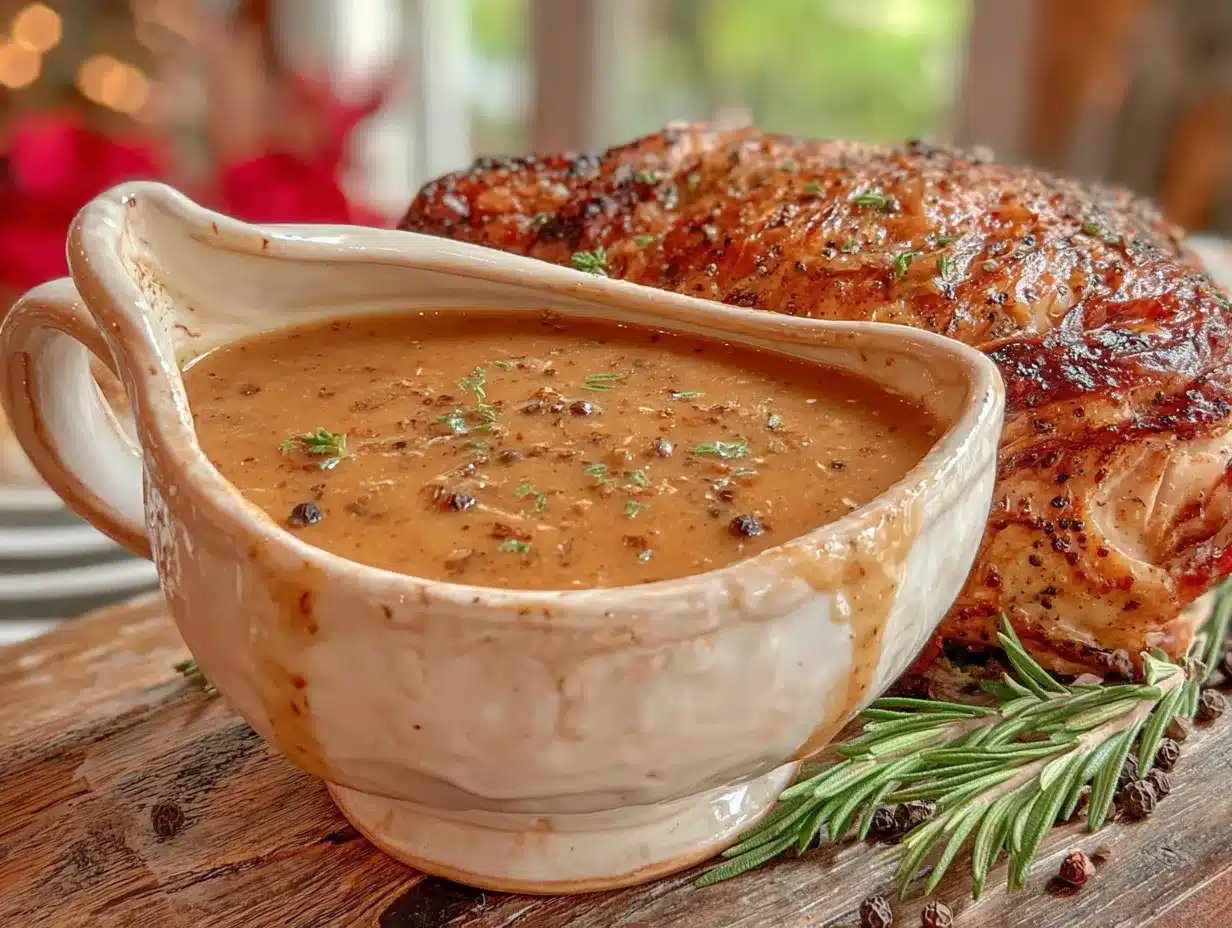
This method breaks down into three parts: making the stock, building the roux, and finishing the gravy. Each step is straightforward, but patience pays off.
Part 1: Roast the Turkey Parts
- Preheat your oven to 400°F (200°C). Place the turkey wings or legs in a single layer in your roasting pan. Drizzle with a tablespoon of olive oil and season generously with salt and pepper.
- Roast for 45 minutes, flipping halfway through. The skin should be deep golden brown and crispy. This browning is where the flavor lives.
- Transfer the roasted parts to a large pot or Dutch oven. Add the chopped onion, carrots, celery, smashed garlic, thyme, rosemary, and bay leaves.
- Pour the broth into the pot. Add enough water to cover everything by about an inch — roughly 2-3 cups. Bring to a boil, then reduce to a gentle simmer.
- Simmer uncovered for 1 hour. Skim any foam that rises to the surface during the first 15 minutes. This keeps your stock clear and clean-tasting.
- Remove from heat. Strain the stock through your fine-mesh strainer into a large bowl or pot. Discard the solids. You should have about 6 cups of rich, golden stock. Set aside.
Part 2: Make the Roux
- In your medium saucepan, melt the butter over medium heat. Once it’s fully melted and starts to foam, add the flour all at once.
- Whisk constantly for 3-4 minutes. The mixture will bubble and darken slightly. You’re looking for a pale golden color — like light honey. This is a blonde roux, which gives body without a heavy taste.
- If using wine, pour it in now. It will sizzle and steam. Whisk vigorously until fully incorporated, about 30 seconds.
Part 3: Finish the Gravy
- Slowly pour the warm turkey stock into the roux, whisking constantly. Start with a thin stream, then increase as the mixture thickens. This prevents lumps from forming.
- Bring the gravy to a gentle simmer. Reduce heat to low and cook for 10-15 minutes, stirring occasionally. It should coat the back of a spoon — thick but pourable.
- Season with salt and pepper. Start with 1 teaspoon of salt and 1/2 teaspoon of pepper. Taste and adjust. Remember, flavors concentrate as the gravy cools.
- Remove from heat. Let it cool completely before transferring to storage containers. Refrigerate for up to 3 days.
When you’re ready to serve, reheat the gravy gently over medium-low heat. Add a splash of broth or water if it’s too thick. Taste and adjust seasoning before serving. The flavor will be even better than the day you made it.
Cooking Tips & Techniques
I’ve made every mistake possible with gravy. Here’s what I learned so you don’t have to repeat my errors.
Don’t rush the roux. The first time I made this, I cranked the heat to high and burned the butter within seconds. Burnt roux tastes bitter and ruins everything. Keep the heat medium, whisk constantly, and watch for that honey color. It takes about 3-4 minutes. Set a timer if you’re distracted.
Warm stock is your friend. Cold stock hitting a hot roux creates instant lumps. I learned this the hard way during a Christmas dinner that looked like chunky pudding. Heat your stock in the microwave or a separate pot before adding it. Room temperature works too, but warm is best.
Season gradually. Gravy concentrates as it simmers and thickens. If you salt it early, it might become inedible by the time it’s done. Add half the salt you think you need, then taste and adjust at the end. You can always add more, but you can’t take it out.
Skim fat carefully. If you’re using the fat separator, pour slowly. If you’re using a spoon, tilt the bowl and skim from the surface. Too much fat makes greasy gravy. Too little leaves it thin and watery. Aim for about 2 tablespoons of fat in your stock.
Make extra stock. I always simmer double the amount I need. Extra stock freezes beautifully for soups, stews, or last-minute gravy emergencies. It’s like a safety net for your holiday cooking.
Variations & Adaptations
This recipe is forgiving. Change it up based on what you have or who you’re feeding.
Gluten-Free Version: Swap the all-purpose flour with a 1:1 gluten-free flour blend. I’ve used Bob’s Red Mill with great results. The roux takes a minute longer to cook, and the texture is slightly less silky, but nobody will notice once it’s on the turkey.
Dairy-Free Version: Use olive oil or vegan butter instead of regular butter. The roux works exactly the same way. I’ve tested this with Miyoko’s vegan butter, and it’s indistinguishable from the original.
Herb-Infused Version: Add a handful of fresh sage leaves to the stock while it simmers. Sage pairs beautifully with turkey and gives the gravy an earthy, almost floral note. Strain it out with the other solids.
Mushroom Lover’s Version: Sauté 8 ounces of sliced cremini mushrooms in a tablespoon of butter before making the roux. Remove them, make the roux in the same pan, then stir the mushrooms back in at the end. It adds an umami punch that’s incredible.
Spicy Kick Version: Add a pinch of cayenne pepper or a dash of smoked paprika to the roux. It won’t make the gravy spicy, just more complex and warm. My brother-in-law swears by this version.
Serving & Storage Suggestions
Serve this gravy warm, not hot. Boiling gravy can break the emulsion and turn greasy. Reheat it gently over medium-low heat, stirring occasionally. If it’s too thick, add a splash of broth or water. If it’s too thin, simmer it a few minutes longer.
This gravy pairs beautifully with roasted turkey, mashed potatoes, stuffing, and green bean casserole. I also love it over open-faced turkey sandwiches the next day. Drizzle it over biscuits for an indulgent breakfast — trust me on this one.
For storage, let the gravy cool completely before refrigerating. Transfer to airtight containers and store for up to 3 days. The flavor actually improves after a day in the fridge as the herbs and spices meld together.
To freeze, pour cooled gravy into freezer-safe bags or containers. Leave an inch of headspace for expansion. Freeze for up to 3 months. Thaw overnight in the refrigerator before reheating. Whisk well after thawing to restore the smooth texture.
Pro tip: Label your containers with the date and amount. Frozen gravy looks identical to frozen broth, and you don’t want to guess on Thanksgiving morning.
Nutritional Information & Benefits
This gravy is indulgent, but it’s made with real, whole ingredients. Here’s the breakdown per 1/4 cup serving:
| Nutrient | Amount |
|---|---|
| Calories | 85 |
| Total Fat | 6g |
| Saturated Fat | 3.5g |
| Cholesterol | 15mg |
| Sodium | 280mg |
| Total Carbohydrates | 6g |
| Dietary Fiber | 0g |
| Sugars | 1g |
| Protein | 2g |
The turkey stock provides collagen and gelatin, which support joint health and skin elasticity. The carrots and onions add vitamins A and C, along with antioxidants. Butter contains fat-soluble vitamins like A, D, E, and K. While this isn’t a health food, it’s a far better choice than store-bought gravy packets loaded with preservatives and artificial flavors. I feel good serving this to my family because I know exactly what’s in it.
Frequently Asked Questions
Can I make this gravy without turkey parts?
Yes. Use chicken thighs or drumsticks with skin. The flavor will be slightly different but still delicious. You can also use store-bought turkey or chicken stock and skip the roasting step entirely — just build the roux and simmer the stock with aromatics for 30 minutes before straining.
Why is my gravy lumpy?
Lumpy gravy usually means your stock was too cold when you added it to the roux, or you didn’t whisk quickly enough. To fix it, pour the lumpy gravy through a fine-mesh strainer into a clean pot. Discard the lumps and reheat gently. Next time, warm your stock before adding it.
Can I double this recipe?
Absolutely. This recipe scales perfectly for larger crowds. Just make sure your pot is big enough — you need room to whisk without splashing. Double everything, including the roasting time for the turkey parts. The simmering time stays the same.
How do I fix gravy that’s too salty?
Add a splash of unsalted broth or water to dilute the salt. You can also add a peeled raw potato to the simmering gravy — it absorbs excess salt. Remove the potato before serving. A teaspoon of lemon juice or vinegar can also balance salty flavors.
Can I use cornstarch instead of flour?
Yes. Mix 2 tablespoons of cornstarch with 1/4 cup of cold water until smooth. Whisk this slurry into the simmering stock instead of making a roux. The texture will be glossier and slightly more jelly-like. Cornstarch gravy doesn’t freeze as well as flour-based gravy, so plan to use it within a day or two.
Conclusion
This make-ahead turkey gravy is the kind of recipe that makes holidays feel manageable. It’s rich, savory, and deeply satisfying — everything you want from a classic gravy, without the last-minute stress. I love it because it gives me back time. Time to enjoy my guests, time to relax, time to actually taste the food I’ve spent days preparing. You can customize it endlessly based on what you have or who you’re feeding. That’s the beauty of a solid base recipe — it’s a starting point, not a rulebook. I’d love to hear how it turns out for you. Leave a comment below with your favorite variation, or share a photo of your holiday table. And if you make it ahead, send me a message letting me know how much calmer your Thanksgiving morning felt. Trust me, Leo would be proud.
Pin This Recipe!

Easy Make-Ahead Turkey Gravy Recipe

This make-ahead turkey gravy is rich, savory, and deeply satisfying, made a full day before the big meal to reduce holiday stress. It delivers perfect texture and deep roasted flavor without any last-minute whisking panic.
- Prep Time: 20 minutes
- Cook Time: 1 hour 45 minutes
- Total Time: 2 hours 5 minutes
- Yield: 6 cups (about 24 servings of 1/4 cup each)
- Category: Sauce
- Cuisine: American
Ingredients
- Turkey wings or legs (2-3 pounds)
- Unsalted butter (1/2 cup, 1 stick)
- All-purpose flour (1/2 cup)
- Yellow onion (1 large, roughly chopped)
- Carrots (2 medium, roughly chopped)
- Celery stalks (2, roughly chopped)
- Garlic cloves (4, smashed)
- Fresh thyme sprigs (4-5)
- Fresh rosemary sprig (1)
- Bay leaves (2)
- Low-sodium chicken or turkey broth (6 cups)
- Dry white wine (1/2 cup, optional)
- Kosher salt and black pepper (to taste)
- Olive oil (1 tablespoon, for roasting)
Instructions
- Preheat your oven to 400°F (200°C). Place the turkey wings or legs in a single layer in your roasting pan. Drizzle with a tablespoon of olive oil and season generously with salt and pepper.
- Roast for 45 minutes, flipping halfway through. The skin should be deep golden brown and crispy.
- Transfer the roasted parts to a large pot or Dutch oven. Add the chopped onion, carrots, celery, smashed garlic, thyme, rosemary, and bay leaves.
- Pour the broth into the pot. Add enough water to cover everything by about an inch — roughly 2-3 cups. Bring to a boil, then reduce to a gentle simmer.
- Simmer uncovered for 1 hour. Skim any foam that rises to the surface during the first 15 minutes.
- Remove from heat. Strain the stock through your fine-mesh strainer into a large bowl or pot. Discard the solids. You should have about 6 cups of rich, golden stock. Set aside.
- In your medium saucepan, melt the butter over medium heat. Once it’s fully melted and starts to foam, add the flour all at once.
- Whisk constantly for 3-4 minutes. The mixture will bubble and darken slightly to a pale golden color — like light honey.
- If using wine, pour it in now. It will sizzle and steam. Whisk vigorously until fully incorporated, about 30 seconds.
- Slowly pour the warm turkey stock into the roux, whisking constantly. Start with a thin stream, then increase as the mixture thickens.
- Bring the gravy to a gentle simmer. Reduce heat to low and cook for 10-15 minutes, stirring occasionally. It should coat the back of a spoon — thick but pourable.
- Season with salt and pepper. Start with 1 teaspoon of salt and 1/2 teaspoon of pepper. Taste and adjust.
- Remove from heat. Let it cool completely before transferring to storage containers. Refrigerate for up to 3 days.
Notes
Don’t rush the roux; keep heat medium and whisk constantly for 3-4 minutes until honey-colored. Warm stock prevents lumps. Season gradually as gravy concentrates. Skim fat carefully for best texture. Make extra stock to freeze for later use.
Nutrition
- Serving Size: 1/4 cup
- Calories: 85
- Sugar: 1
- Sodium: 280
- Fat: 6
- Saturated Fat: 3.5
- Carbohydrates: 6
- Protein: 2
Keywords: make-ahead gravy, turkey gravy, Thanksgiving gravy, holiday gravy, easy gravy, homemade gravy, gluten-free gravy option, dairy-free gravy option